
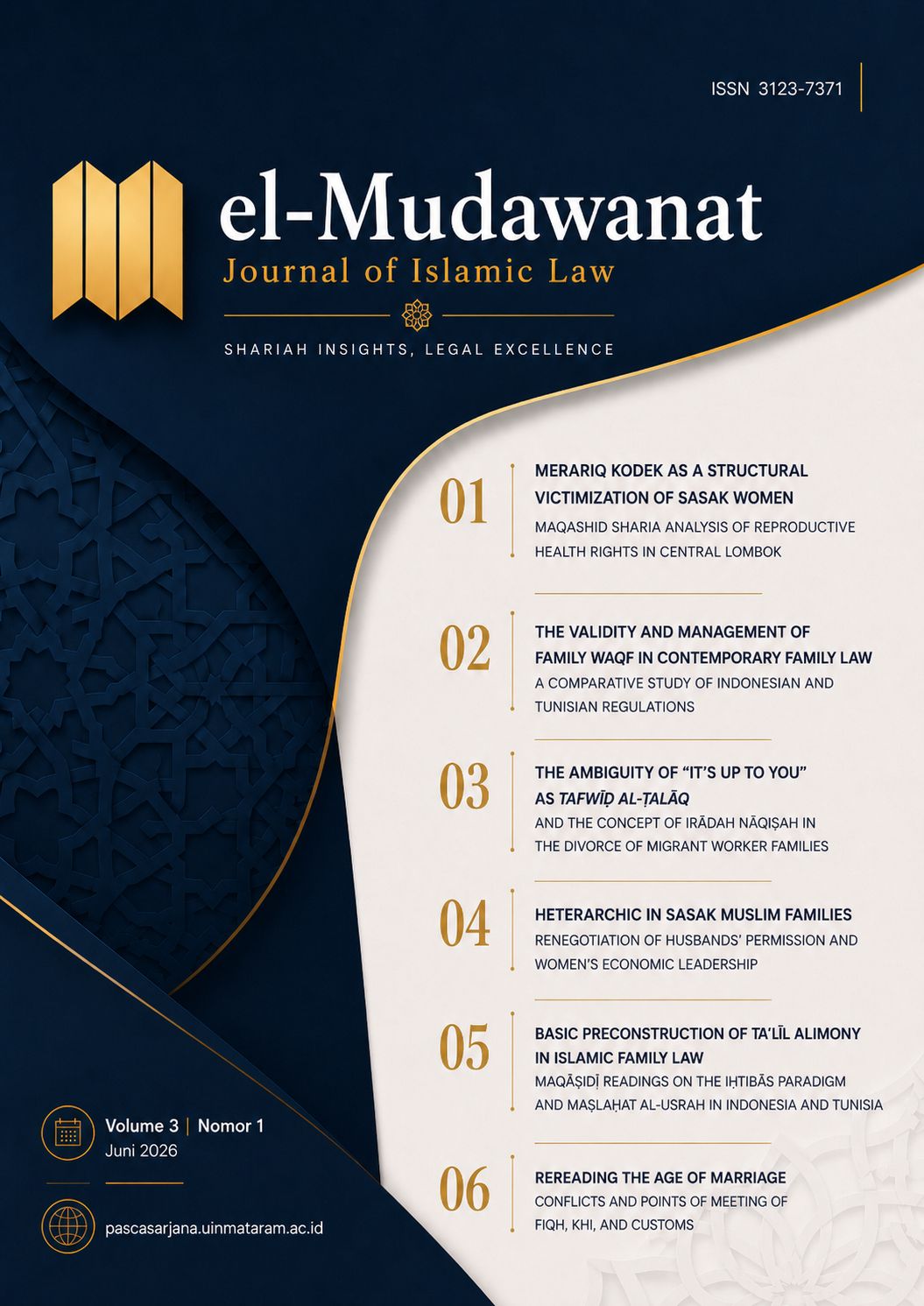
The Validity And Management Of Family Waqf In Contemporary Family Law: A Comparative Study Of Indonesian And Tunisian Regulations
DOI:
https://doi.org/10.20414/mudawanat.vi.329Keywords:
family waqf, waqf ahlī, ḥabūs, waqf regulation, maqāṣid al-syarī‘ahAbstract
Family endowment (waqf ahlī/dzurrī) is among the oldest institutions of Islamic family law, yet in the contemporary era it is one of the most polarised. Indonesia retains its validity through the normative construction of Law No. 41 of 2004 and the Compilation of Islamic Law (KHI), whereas Tunisia abolished it entirely through the decree of 18 July 1957. This study aims to describe the regulatory framework, analyse its underlying legal philosophy, and compare the social implications of both models. The method employed is comparative juridical-normative, using statutory, historical, and conceptual approaches. Primary data consists of statutory regulations from both countries and classical jurisprudential literature of the four Sunni schools, while secondary data is drawn from indexed journals of the last five years. The study yields three main findings. First, the difference between the two countries does not concern the canonical validity of family waqf but rather the state’s policy choice in balancing private rights with public welfare. Second, Indonesia adopts a controlled-integration path while Tunisia took a structural-elimination path. Third, reconceptualising family waqf through the maqāṣid al-syarī‘ah approach — particularly ḥifẓ al-māl and ḥifẓ al-nasl — may yield a conditional-integrative model that combines the strengths of both systems
References
Anggraini, Rifka Dwi, Nurul Dini Dewi, dan Muhammad Rofiq. “Optimalisasi Potensi Wakaf di Indonesia: Tantangan dan Peran Digitalisasi dalam Penguatan Manfaat Wakaf bagi Masyarakat.” Journal of Islamic Business Management Studies 5, no. 1 (2024). https://doi.org/10.51875/jibms.v5i1.292.
‘Aṭiyyah, Jamāl al-Dīn. Naḥwa Taf‘īl Maqāṣid al-Syarī‘ah. Damaskus: Dār al-Fikr, 2003.
Bashori, Achmad, dan Mohammad Romli. “Wakaf Keluarga Perspektif UU No. 41 Tahun 2004 dan Maqāṣid al-Usrah Jamāl al-Dīn ‘Aṭiyyah.” Mahakim: Journal of Islamic Family Law 5, no. 2 (2021). https://jurnalfasya.iainkediri.ac.id/index.php/mahakim/article/view/137.
Bouguerra, Salma. The End of Islamic Family Law: Tunisia’s 1956 Personal Status Code. Honors Thesis, Bates College, 2019. https://scarab.bates.edu/honorstheses/294.
Cipto, Sutarto, Zainul Arifin, Saiful Rizal Ahmad, dan Hari Restu Supriati. “Waqf Law in the Muslim World: A Study of the Organization and Administration of Waqf in Tunisia,” Vol. 3, No. 1 (2025). https://www.researchgate.net/publication/389029778.
Direktorat Pemberdayaan Wakaf, Direktorat Jenderal Bimbingan Masyarakat Islam, Kementerian Agama RI. Laporan Akhir Tim Pengkajian tentang Aspek Hukum Wakaf Uang. Jakarta: BPHN, 2009. https://bphn.go.id/data/documents/pkj_aspek_hukum_wakaf_uang.pdf .
Hunafa: Jurnal Studia Islamika. “Pembaruan Hukum Keluarga: Wasiat untuk Ahli Waris (Studi Komparatif Tunisia, Syria, Mesir, dan Indonesia),” Vol. 20, No. 1 (2023). https://jurnalhunafa.org/index.php/hunafa/article/view/364.
Ibn Qudāmah, Muwaffaq al-Dīn ‘Abd Allāh b. Aḥmad. Al-Mughnī. Riyaḍ: Dār ‘Ālam al-Kutub, 1997.
Indonesia. Instruksi Presiden Nomor 1 Tahun 1991 tentang Penyebarluasan Kompilasi Hukum Islam (Buku III: Hukum Perwakafan, Pasal 215–229).
Indonesia. Undang-Undang Nomor 41 Tahun 2004 tentang Wakaf. Lembaran Negara Republik Indonesia Tahun 2004 Nomor 159. https://www.bwi.go.id/wp-content/uploads/2019/09/Undang-undang-No.-41-2004-Tentang-Wakaf.pdf.
Indonesia. Peraturan Pemerintah Nomor 42 Tahun 2006 tentang Pelaksanaan Undang-Undang Nomor 41 Tahun 2004 tentang Wakaf.
Indonesia. Peraturan Pemerintah Nomor 25 Tahun 2018 tentang Perubahan atas Peraturan Pemerintah Nomor 42 Tahun 2006.
Islamic Center for Economics and Culture. The Tunisian Waqf Experience: A Historical-Legal Review. ICEC, 2025. https://icec.my/tunisian-waqf/.
Al-Kāsānī, ‘Alā’ al-Dīn. Badā’i‘ al-Ṣanā’i‘ fī Tartīb al-Sharā’i‘. Beirut: Dār al-Kutub al-‘Ilmiyyah, t.t.
Al-Khaṭīb al-Syarbīnī, Muḥammad b. Aḥmad. Mughnī al-Muḥtāj ilā Ma‘rifati Ma‘ānī Alfāẓ al-Minhāj. Beirut: Dār al-Kutub al-‘Ilmiyyah, 1994.
Al-Kubaisī, Muḥammad ‘Ubayd. Aḥkām al-Waqf fī al-Sharī‘ah al-Islāmiyyah. Baghdad: Maṭba‘at al-Irshād, 1972.
Mahrus, Ida Ayu Musfiroh, dan Gita Septi Rachmah. “Manajemen Aset Wakaf untuk Pengembangan Pendidikan Islam.” Edukasi Islami: Jurnal Pendidikan Islam 12, no. 4 (2024). https://doi.org/10.30868/ei.v12i001.8148.
Marzoughi, Aida. “Tunisia’s Ancient Social Safety Net Is Seen as an Untapped Resource.” The Christian Science Monitor, 7 April 2022. https://www.csmonitor.com/World/Middle-East/2022/0407/Giving-back-is-a-universal-form-of-faith.-Can-Tunisia-revive-unused-trusts.
Sugiyanti, Eti, Komaruddin, dan Aripin Ahmad Hakim. “Analisis Mengenai Konsep dan Regulasi Wakaf di Indonesia.” Iqtishad Sharia: Journal of Sharia Economic Law and Islamic Finance 3, no. 2 (2025). https://journal.albadar.ac.id/index.php/iqtishadsharia/article/view/221.
Al-Syāṭibī, Abū Isḥāq Ibrāhīm b. Mūsā. Al-Muwāfaqāt fī Uṣūl al-Syarī‘ah. Kairo: Dār Ibn ‘Affān, 1997.
Tunisia. Décret du 31 mai 1956 portant suppression des ḥabūs publics.
Tunisia. Code du Statut Personnel (Majallat al-Aḥwāl al-Shakhṣiyyah), promulgué le 13 août 1956.
Tunisia. Décret du 18 juillet 1957 portant suppression des ḥabūs privés (ahlī) et mixtes (mukhtalaṭ).
Tunisia. Loi No. 24 du 6 mars 2000 portant régularisation des biens ḥabūs.
Al-Zuḥaylī, Wahbah Muṣṭafā. Al-Fiqh al-Islāmī wa Adillatuhu. Vol. 10. Damaskus: Dār al-Fikr, t.t.


 a
a