
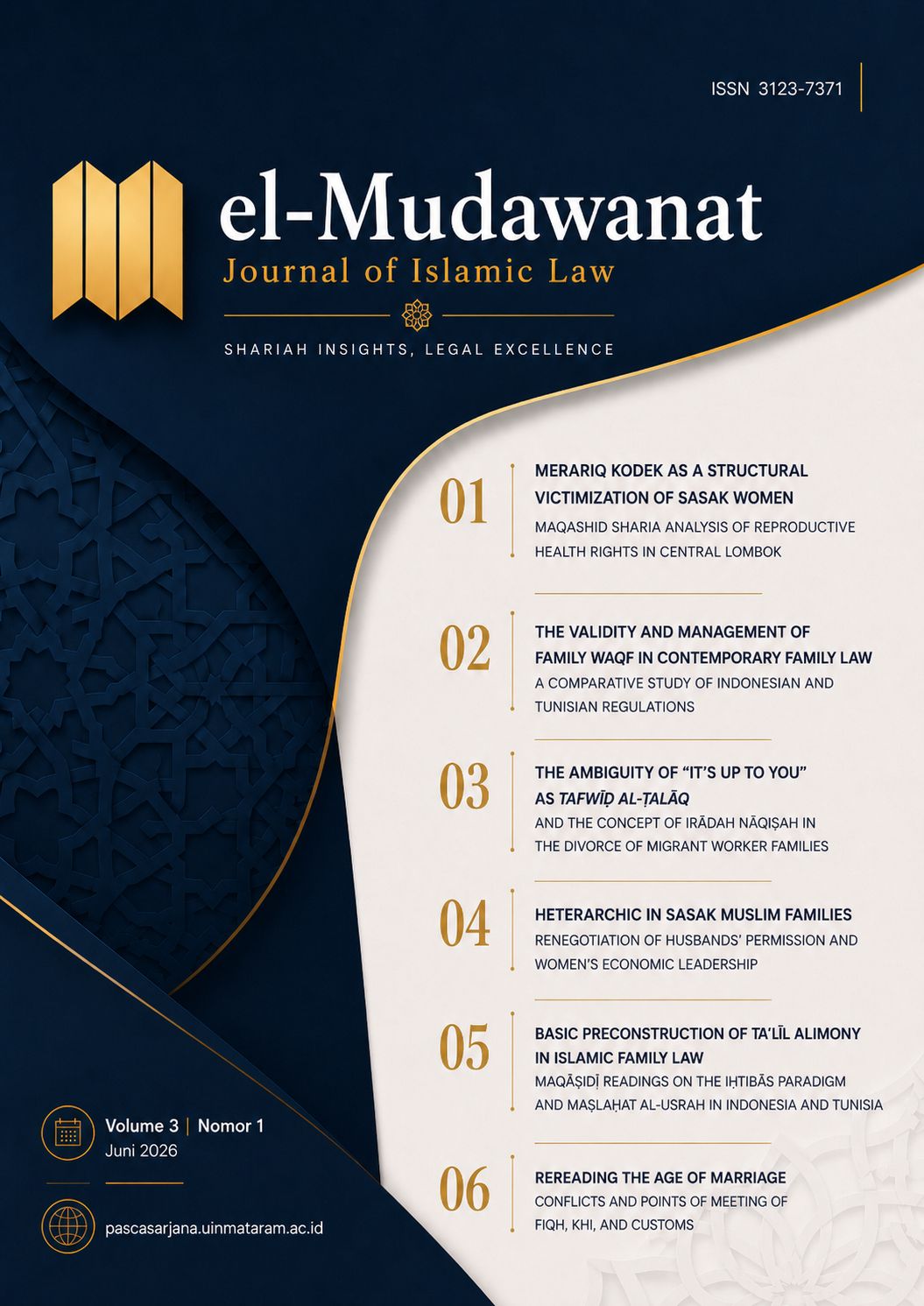
Merariq Kodek as a Structural Victimization of Sasak Women: Maqashid Sharia Analysis of Reproductive Health Rights in Central Lombok
DOI:
https://doi.org/10.20414/mudawanat.vi.328Keywords:
Maqasid al-Shariah, Merariq Kodek, Reproductive Health, Sasak Women, Structural VictimizationAbstract
This study aims to analyze the practice of merariq kodek as a form of structural victimization against Sasak women and to examine its impact on women’s reproductive health rights from the perspective of maqashid sharia in Central Lombok. The study employs a qualitative method using a socio-legal approach and a critical paradigm through literature review of various journals, previous studies, regulations, and studies on Sasak culture. The findings reveal that merariq kodek is no longer merely understood as a traditional Sasak marriage custom, but has transformed into a social mechanism that reinforces patriarchal culture and the subordination of women. In practice, women often lose the right to determine their own life choices due to customary pressures, social stigma, and family honor constructions that force them into early marriage. This condition causes women to experience structural victimization resulting in loss of access to education, economic dependency, psychological pressure, anxiety, social trauma, and emotional unpreparedness in facing married life. In addition, early marriage practices also increase reproductive health risks such as anemia, preeclampsia, miscarriage, low birth weight, and premature birth. From the perspective of maqashid sharia, such practices contradict the principles of hifz al-nafs, hifz al-nasl, and hifz al-‘irdh because they threaten the protection of life, lineage, and women’s dignity. This study emphasizes the importance of reinterpreting local culture through religious, educational, and legal protection approaches to prevent child marriage practices and strengthen the protection of Sasak women’s reproductive health rights in Central Lombok
References
Maqāṣid Al-Sharī’ah Paradigm in Dangers of Forced Marriage Against Women.” Sawwa Jurnal Studi Gender 18, no. 2 (2023): 147–68. doi:10.21580/sa.v18i2.17280.
Amirah, Nabilla, and Yusnita Eva. “The Judge’s Refusal of the Application for Marriage Dispensation.” Kawanua International Journal of Multicultural Studies 4, no. 1 (2023): 69–74. doi:10.30984/kijms.v4i1.592.
Azwar, Wahyu, Deviana Mayasari, Aliahardi Winata, Malami M Garba, and Isnaini. “Exploration of the Merariq Tradition in Sasak Lombok, Indonesia: Analysis in Islamic Law and Socio-Cultural Dynamics Perspectives.” Ibda Jurnal Kajian Islam Dan Budaya 22, no. 1 (2024): 23–38. doi:10.24090/ibda.v22i1.10766.
Chakole, Swarupa, Shivani Akre, Kapil Sharma, Praful Wasnik, and Mayur Wanjari. “Unwanted Teenage Pregnancy and Its Complications: A Narrative Review.” Cureus, 2022. doi:10.7759/cureus.32662.
Charles, Maria, Roger Friedland, Janet Afary, and Rujun Yang. “Complicating Patriarchy: Gender Beliefs of Muslim Facebook Users in the Middle East, North Africa, and South Asia.” Gender & Society 37, no. 1 (2022): 91–123. doi:10.1177/08912432221137909.
Djawas, Mursyid, Abidin Nurdin, Muslim Zainuddin, Idham Idham, and Zahratul Idami. “Harmonization of State, Custom, and Islamic Law in Aceh: Perspective of Legal Pluralism.” Hasanuddin Law Review 10, no. 1 (2024): 64. doi:10.20956/halrev.v10i1.4824.
Fairiza, Andre, and Rendra Widyatama. “Merariq Dalam Pernikahan Suku Sasak: Analisis Komunikasi Dan Dinamika Sosial Dalam Ritual Penculikan.” Jurnal Analisa Sosiologi 13, no. 1 (2024). doi:10.20961/jas.v13i1.74926.
Hamzaoğlu, Mehtap. “Honor Killings in Traditional Societies: Revisiting the Case of Türkiye After Istanbul Convention Withdrawal.” Lectio Socialis 8, no. 2 (2024): 73–98. doi:10.47478/lectio.1454452.
Kassa, Getachew M, Ayodele O Arowojolu, Akin‐Tunde A Odukogbe, and Alemayehu W Yalew. “Adverse Neonatal Outcomes of Adolescent Pregnancy in Northwest Ethiopia.” Plos One 14, no. 6 (2019): e0218259. doi:10.1371/journal.pone.0218259.
Kurniawan, Taufiq, Febria Syifa’unnufus, and Remanda N Tamara. “Tinjauan Hukum Pidana Terhadap Adat Merariq Di Masyarakat Lombok Tengah.” Jurnal Riset Sosial Humaniora Dan Pendidikan 2, no. 1 (2023): 127–39. doi:10.56444/soshumdik.v2i1.566.
Li, Z Y. “Marital Rape as Structual Violence in the Legal System.” Lecture Notes in Education Psychology and Public Media 42, no. 1 (2024): 146–51. doi:10.54254/2753-7048/42/20240693.
Ningrum, Rhadika, Dhesi A Astuti, and Anjarwati. “The Relationship Between Early Marriage and Mental Health in Adolescent Girls in the KUA Ngemplak Yogyakarta.” Jurnal Promkes 11, no. 2 (2023): 141–48. doi:10.20473/jpk.v11.i2.2023.141-148.
Rizki, Darlin, Frina Oktalita, and Ali Sodiqin. “Maqasid Sharia Perspective in Changes the Marriage Age Limits for Women According to Law Number 16 of 2019.” Al-Istinbath Jurnal Hukum Islam 7, no. 2 (2022): 501. doi:10.29240/jhi.v7i2.4016.
Saidun, and Encung Encung. “Sasak Islam in the Merariq Tradition in Central Lombok, Tumpak Village.” Lectures Journal of Islamic and Education Studies 2, no. 4 (2023): 211–27. doi:10.58355/lectures.v2i4.69.
Syamsiah, and Adisa C Rianti. “Social Construction of Young Married Couples in Parenting Children in South Jakarta.” Ijess International Journal of Education and Social Science 3, no. 2 (2022): 49–54. doi:10.56371/ijess.v3i2.99.
Walklate, Sandra, and Kate Fitz‐Gibbon. “Why Criminalise Coercive Control? The Complicity of the Criminal Law in Punishing Women Through Furthering the Power of the State.” International Journal for Crime Justice and Social Democracy 9, no. 4 (2021). doi:10.5204/ijcjsd.1829.
Xie, Yanxia, Xiaodong Wang, Yi Mu, Zheng Liu, Yanping Wang, Xiaohong Li, Li Dai, et al. “Characteristics and Adverse Outcomes of Chinese Adolescent Pregnancies Between 2012 and 2019.” Scientific Reports 11, no. 1 (2021). doi:10.1038/s41598-021-92037-x.
Yamin, Alicia E. “Power, Politics and Knowledge Claims: Sexual and Reproductive Health and Rights in the SDG Era.” Global Policy 10, no. S1 (2019): 52–60. doi:10.1111/1758-5899.12598.


 a
a