
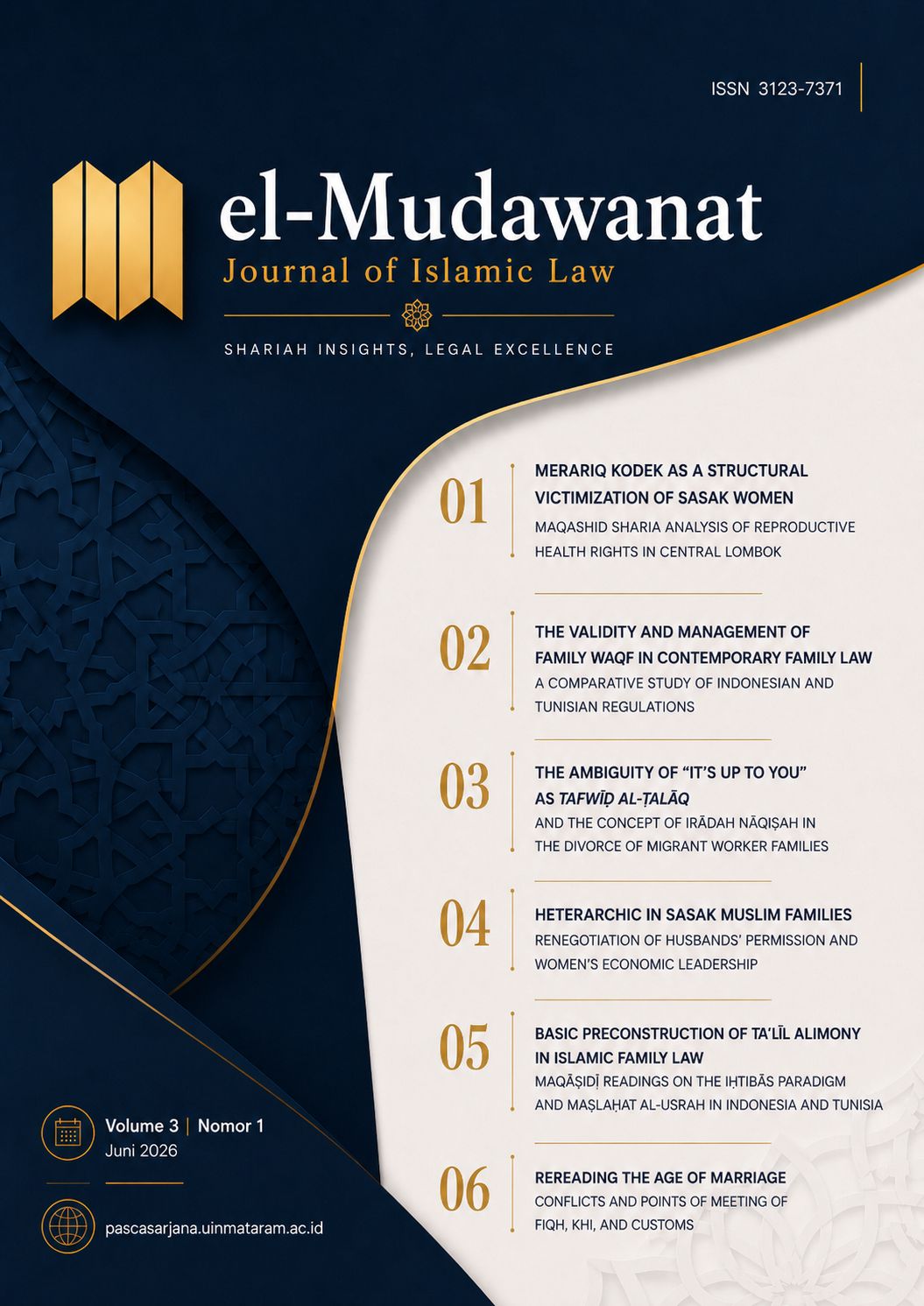
Basic Preconstruction Of Taʿlīl Alimony In Islamic Family Law: Maqāṣidī Readings On The Iḥtibās Paradigm And Maṣlaḥat Al-Usrah In Indonesia And Tunisia
DOI:
https://doi.org/10.20414/mudawanat.vi.396Keywords:
taʿlīl basis of maintenance, iḥtibās, maṣlaḥat al-usrah, masālik al-ʿillah, Islamic family lawAbstract
This article examines the reconstruction of the taʿlīl basis of wife's maintenance (nafkah) in contemporary Islamic family law, analyzing indications of a paradigm shift from iḥtibās (wife's confinement) toward maṣlaḥat al-usrah (family welfare) through a comparative study of Indonesia's Compilation of Islamic Law (KHI) and Tunisia's Code du Statut Personnel (CSP). Employing comparative-analytical methodology (muqāranah) with taʿlīlī reasoning through masālik al-ʿillah mechanisms — particularly taḥqīq al-manāṭ and takhrīj al-manāṭ — this study traces whether the 1993 amendment to CSP Article 23 contains a reconstruction of the taʿlīl paradigm that can be read as a shift from the iḥtibās framework toward principles of solidarity and family welfare. Mindful of uṣūlī debates on the distinction between ʿillat, ḥikmah, and maqṣad — wherein maṣlaḥat al-usrah is categorially closer to maqṣad tashrīʿī than to technical ʿillat qiyāsiyyah — this article argues that Tunisia's reform represents a reconstruction of the taʿlīl basis of nafkah with consequences for redefining its prerequisites and obligated parties. Maqāṣid analysis through Ibn ʿĀshūr and Jasser Auda demonstrates that this reconstruction better aligns with ḥifẓ al-nafs and ḥifẓ al-nasl in the context of contemporary social realities. Methodological implications for KHI reform in Indonesia are also formulated.
References
A. Kitab Turāṡ dan Buku Uṣūl al-Fiqh
Al-Āmidī, ʿAlī ibn Muḥammad. Al-Iḥkām fī Uṣūl al-Aḥkām. Juz III. Beirut: Dār al-Kutub al-ʿIlmiyyah, 1985.
Al-Ghazālī, Abū Ḥāmid Muḥammad. Al-Mustaṣfā min ʿIlm al-Uṣūl. Juz II. Beirut: Dār al-Kutub al-ʿIlmiyyah, 1993.
Al-Kāsānī, ʿAlāʾ al-Dīn. Badāʾiʿ al-Ṣanāʾiʿ fī Tartīb al-Sharāʾiʿ. Juz IV. Beirut: Dār al-Kutub al-ʿIlmiyyah, 1986.
Al-Nawāwī, Muḥyī al-Dīn. Al-Majmūʿ Sharḥ al-Muhaḏḏab. Juz XVIII. Jeddah: Maktabah al-Irshād, t.th.
Al-Sharbīnī, Shams al-Dīn. Mughnī al-Muḥtāj ilā Maʿrifat Maʿānī Alfāẓ al-Minhāj. Juz III. Beirut: Dār al-Maʿrifah, 1997.
Al-Shāṭibī, Ibrāhīm ibn Mūsā. Al-Muwāfaqāt fī Uṣūl al-Sharīʿah. Juz II. Beirut: Dār al-Maʿrifah, 1975.
Al-Ṭūfī, Najm al-Dīn. Risālah fī Riʿāyat al-Maṣlaḥah. Diedit oleh Aḥmad ʿAbd al-Raḥīm al-Sāyiḥ. Kairo: al-Dār al-Miṣriyyah al-Lubnāniyyah, 1993.
Al-Zarkashī, Badr al-Dīn. Al-Baḥr al-Muḥīṭ fī Uṣūl al-Fiqh. Juz V. Kuwait: Wizārat al-Awqāf, 1992.
Ibn Qudāmah, Muwaffaq al-Dīn. Al-Mughnī. Juz IX. Kairo: Maktabah al-Qāhirah, 1968.
B. Buku Fikih dan Maqāṣid Kontemporer
Abū Zahrah, Muḥammad. Uṣūl al-Fiqh. Kairo: Dār al-Fikr al-ʿArabī, t.th.
Al-Qaraḍāwī, Yūsuf. Madkhal li-Dirāsat al-Sharīʿah al-Islāmiyyah. Kairo: Maktabah Wahbah, 1990.
Al-Zuḥaylī, Wahbah. Al-Fiqh al-Islāmī wa Adillatuh. Juz VII. Damaskus: Dār al-Fikr, 1985.
Auda, Jasser. Maqasid al-Shariah as Philosophy of Islamic Law: A Systems Approach. London: International Institute of Islamic Thought (IIIT), 2008.
Faqihuddin Abdul Kodir. Qiraah Mubadalah: Tafsir Progresif untuk Keadilan Gender dalam Islam. Yogyakarta: IRCiSoD, 2019.
Ibn ʿĀshūr, Muḥammad al-Ṭāhir. Maqāṣid al-Sharīʿah al-Islāmiyyah. Amman: Dār al-Nafāʾis, 2001.
Mir-Hosseini, Ziba. Marriage on Trial: A Study of Islamic Family Law. London: I.B. Tauris, 2000.
Wadud, Amina. Quran and Woman: Rereading the Sacred Text from a Woman's Perspective. Oxford: Oxford University Press, 1999.
C. Buku Hukum Keluarga Komparatif dan Sejarah
Badan Pusat Statistik. Statistik Gender Tematik: Potret Ketimpangan Gender dalam Ekonomi. Jakarta: BPS, 2021.
Charrad, Mounira M. States and Women's Rights: The Making of Postcolonial Tunisia, Algeria, and Morocco. Berkeley: University of California Press, 2001.
El Alami, Dawoud dan Doreen Hinchcliffe. Islamic Marriage and Divorce Laws of the Arab World. London: Kluwer Law International, 1996.
ILO. Women at Work: Trends 2016. Geneva: International Labour Office, 2016.
Perkins, Kenneth. A History of Modern Tunisia. Cambridge: Cambridge University Press, 2004.
Welchman, Lynn. Women and Muslim Family Laws in Arab States: A Comparative Overview of Textual Development and Advocacy. Amsterdam: Amsterdam University Press, 2007.
D. Artikel Jurnal Internasional
Husain, Fauzia. "Redefining the Qiwamah: Spousal Maintenance in Tunisian Law." Islamic Law and Society 18, no. 3-4 (2011): 359-385.
Sonneveld, Nadia. "From the Mahkama to the Markaz: Seeking Khulʿ Divorce in Egypt." Islamic Law and Society 16, no. 2 (2009): 190-220.
E. Peraturan Perundang-Undangan dan Instrumen Internasional
Code du Statut Personnel (Majallat al-Aḥwāl al-Shakhṣiyyah) Tunisia. Décret du 13 août 1956, Journal Officiel de la République Tunisienne No. 65, 17 Agustus 1956.
Convention on the Elimination of All Forms of Discrimination against Women (CEDAW), 1979.
Kompilasi Hukum Islam (KHI), Instruksi Presiden No. 1 Tahun 1991.
Loi n° 93-74 du 12 juillet 1993. Journal Officiel de la République Tunisienne No. 53, 13 Juli 1993.
Undang-Undang No. 1 Tahun 1974 tentang Perkawinan.


 a
a