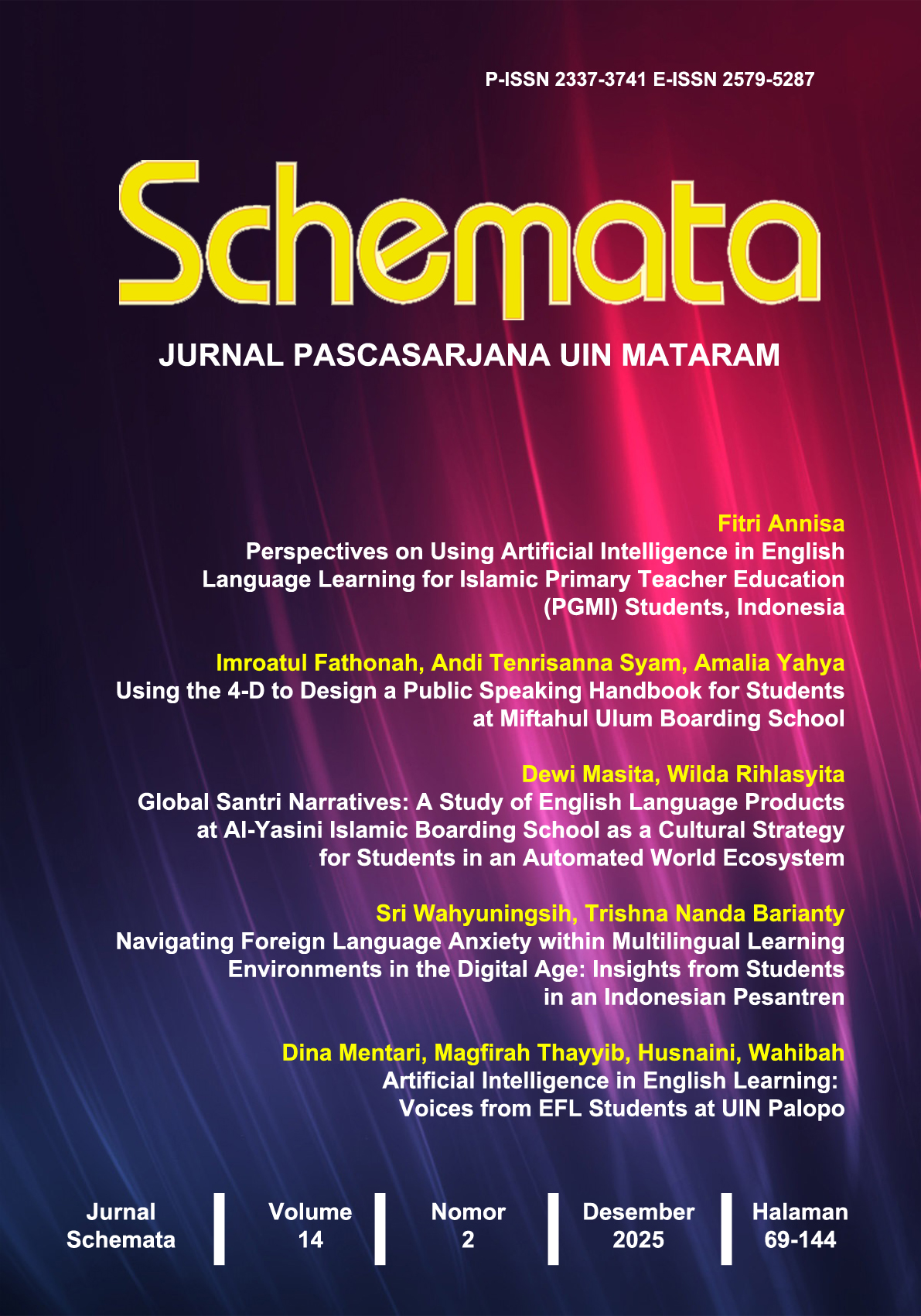
Artificial Intelligence in English Learning: Voices from EFL Students at UIN Palopo
Keywords:
Artificial Intelligence, English as Foreign Language (EFL), English LearningAbstract
In the digital era, AI tools such as ChatGPT, Grammarly, and Duolingo have increasingly been used to support language acquisition. However, students' experiences and attitudes toward these tools remain underexplored in the local academic context. This research aimed to identify both the perceived advantages and disadvantages of AI in English learning. A qualitative narrative method was employed, involving 16 sixth-semester English students selected through purposive sampling. Data were collected using open-ended questionnaires distributed via Google Forms. The findings reveal that students generally perceive AI positively, noting its role in enhancing accessibility, personalized learning, and improvement in key language skills—speaking, writing, reading, and listening. Nevertheless, concerns were raised about over-reliance on technology, reduced classroom interaction, and limited accuracy in context-sensitive tasks. Internet connectivity issues and access restrictions on premium features were also highlighted. The study concludes that while AI offers valuable support in EFL learning, it should be integrated thoughtfully alongside human interaction and traditional pedagogies. These insights can inform educators, institutions, and future researchers in designing balanced, student-centered approaches to AI-assisted language education
Downloads
Published
How to Cite
Issue
Section
License
Copyright (c) 2026 Schemata: Jurnal Pascasarjana UIN Mataram

This work is licensed under a Creative Commons Attribution 4.0 International License.
Schemata: Jurnal Pascasarjana UIN Mataram is licensed under a Creative Commons Attribution 4.0 International License.