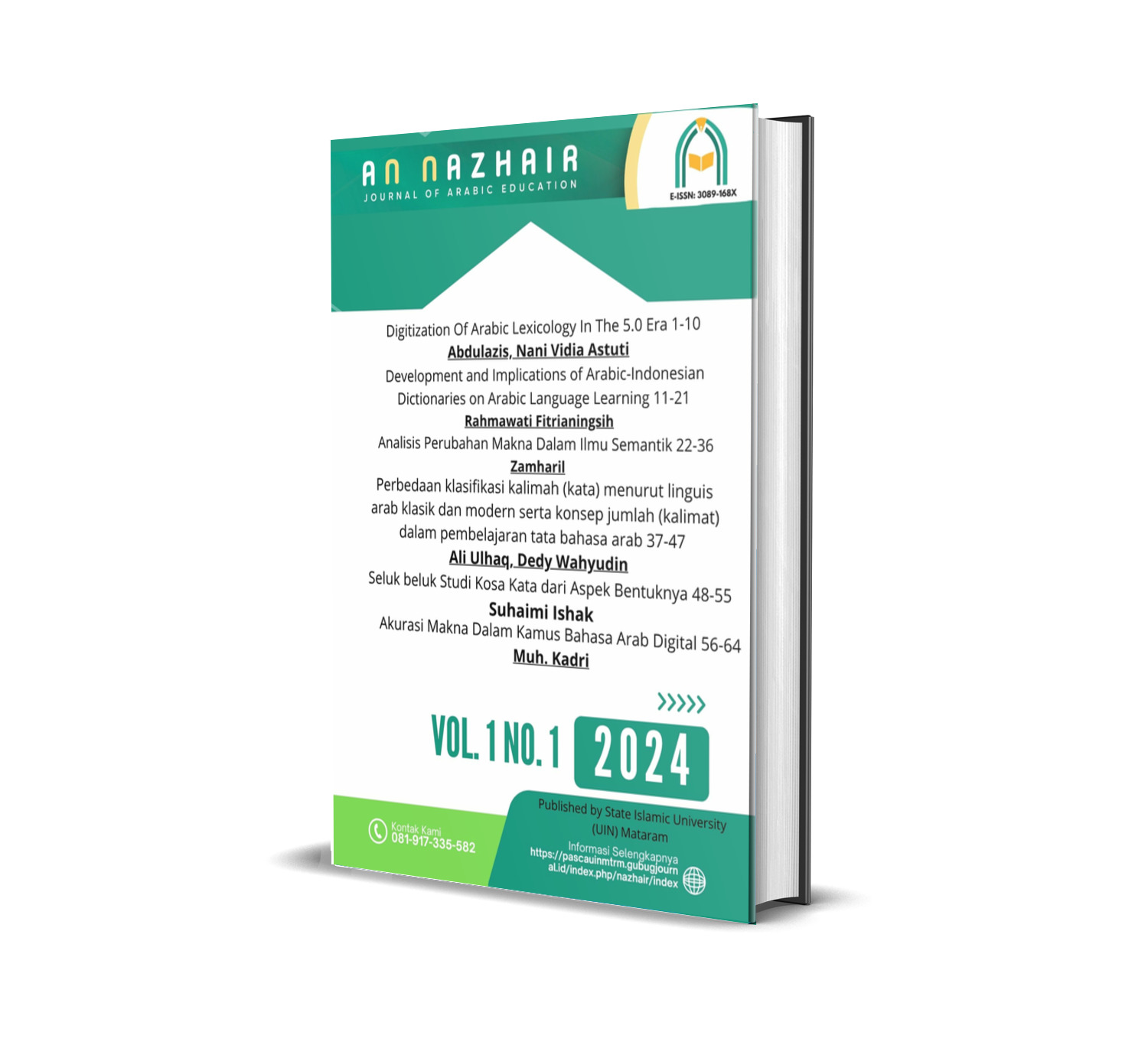
Perbedaan klasifikasi kalimah (kata) menurut linguis arab klasik dan modern serta konsep jumlah (kalimat) dalam pembelajaran tata bahasa arab
DOI:
https://doi.org/10.20414/nazhair.v1i1.16Keywords:
lasifikasi kalimah, linguis arab klasik, modern, konsep jumlah, pembelajaran, tata bahasa arabAbstract
The purpose of this study is to analyze the difference in Arabic word classification according to classical and modern Arabic linguists and how the concept of sentences in learning Arabic grammar. This study uses a qualitative approach by conducting library research. Based on the results of the discussion, the classification of words according to classical Arabic linguists is divided into three types, namely; isim, fi'il, and letters. Meanwhile, the classification of words according to modern Arabic linguists (see: tamam hasan) is divided into seven types, namely; isim, nature, fi'il, damīr, khalīfah, zarf and adāh. Then the concept of deep sentences in learning Arabic grammar is divided into two sentence patterns which are referred to as the Jumlah Ismiyyah and the Jumlah Fi'liyyah. The Jumlah Ismiyyah is a type of sentence whose structure begins with the word isim and usually consists of mubtada' and khabar even though in certain conditions the khabar comes first. While the Jumlah fi'liyyah is a sentence pattern whose structure consists of fi'il and fa'il or fi'il and na'ibul fa'il, while Al-mafaa'iil (Maf'ul bih, maf'ul fiih, maf'ul ma'ah, maf'ul muthlaq, maf'ul liajlih) and Al-afaa'iil (hal, tamyiz, and istitsna') come as a complement then Jar Majrur and Zaraf mazruf as information about time or place.
Downloads
Published
How to Cite
Issue
Section
License
Copyright (c) 2025 An Nazhair: Journal of Arabic Education

This work is licensed under a Creative Commons Attribution-NonCommercial-NoDerivatives 4.0 International License.