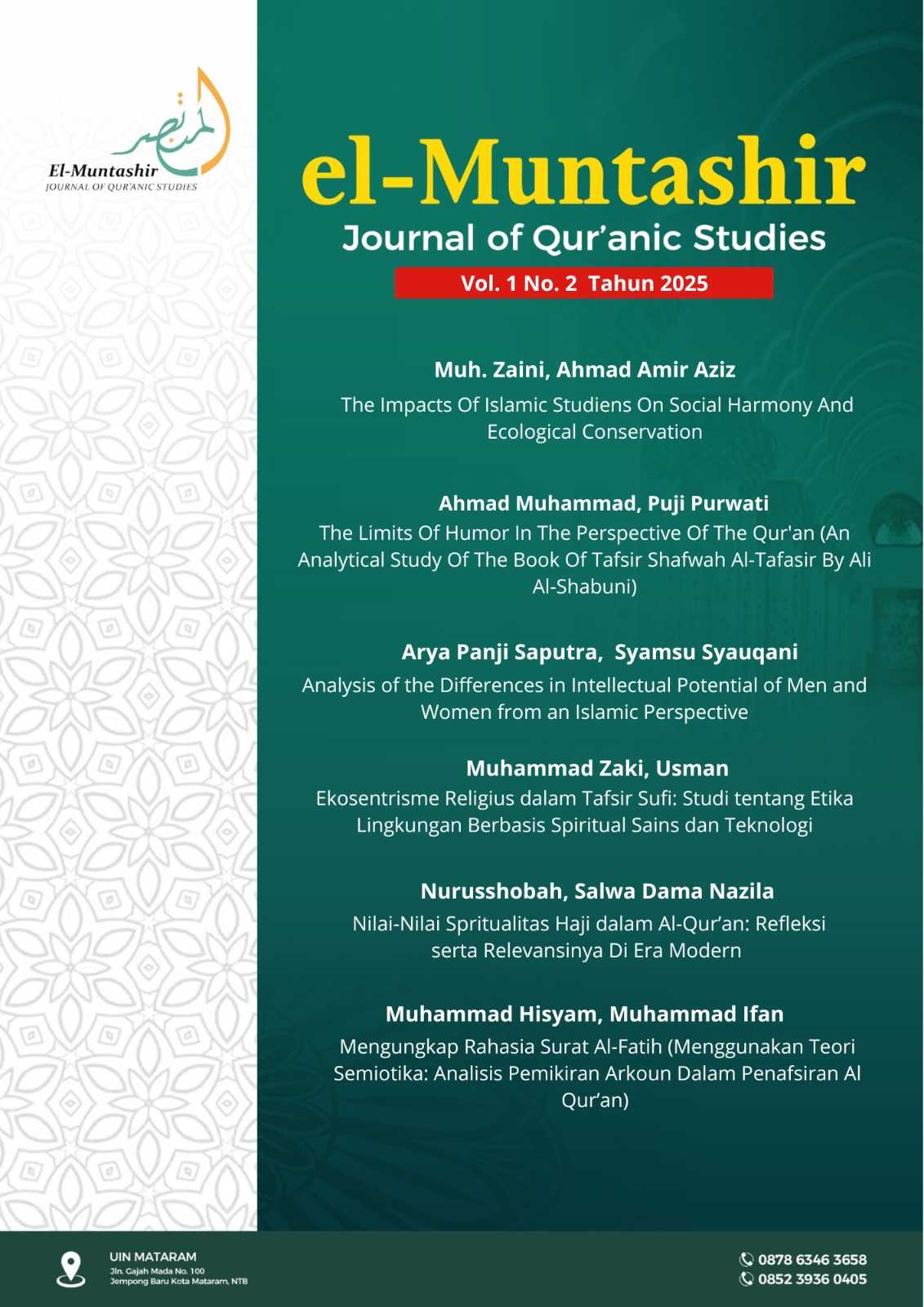
Ekosentrisme Religius dalam Tafsir Sufi: Studi tentang Etika Lingkungan Berbasis Spiritual Sains dan Teknologi
DOI:
https://doi.org/10.20414/elmuntashir.v1i2.93Keywords:
Religious Ecocentrism; Sufi Exegesis; Environmental Ethics; Science and Technology; Ecological SpiritualityAbstract
A Religious ecocentrism in Sufi exegesis offers a spiritual paradigm to re-examine environmental ethics in the era of science and technology. This study aims to explore how Sufi interpretations of the Qur’an provide a theological foundation for ecological awareness and how such insights can contribute to the development of environmental ethics that integrate spirituality, scientific knowledge, and technological innovation. This research employs a qualitative library study method focusing on both classical Sufi exegesis (such as Ibn ʿArabī) and contemporary works (such as al-Misbah by Quraish Shihab), philosophical writings on ecosophy, as well as modern discourse on environmental ethics. The analysis applies a descriptive-interpretative approach to identify the interconnections between Sufi spiritual insights, ecological consciousness, and the role of science and technology in addressing environmental crises. The findings indicate that Sufi exegesis emphasizes the sacredness of nature as a manifestation of divine attributes, which encourages humans to act as khalifah with ethical responsibility toward all creation. Religious ecocentrism integrates transcendental values with ecological wisdom, offering an alternative to anthropocentric paradigms in modern development. Furthermore, the dialogue between spirituality and scientific-technological progress opens new possibilities for constructing an integrative framework of environmental ethics that is spiritually rooted yet practically relevant. This study highlights the importance of reinterpreting Islamic spiritual traditions in responding to ecological crises. By drawing from Sufi perspectives, environmental ethics are enriched with transcendental values that provide deeper motivation for sustainable practices. Practically, the study implies: (1) environmental policies grounded in spiritual-ecological values; (2) ecological-spiritual education, especially in Islamic schools and pesantren; and (3) strengthening eco-social movements inspired by Sufi values such as amanah (trust), simplicity, and rahmah (compassion). This integrative approach contributes to academic debates on ecotheology and ecospirituality while offering practical insights for scholars, policymakers, and religious communities concerned with environmental sustainability.
Downloads
Published
Issue
Section
License
Copyright (c) 2025 El Muntashir: Journal of Quranic Studies

This work is licensed under a Creative Commons Attribution-ShareAlike 4.0 International License.





 This work is licensed under a