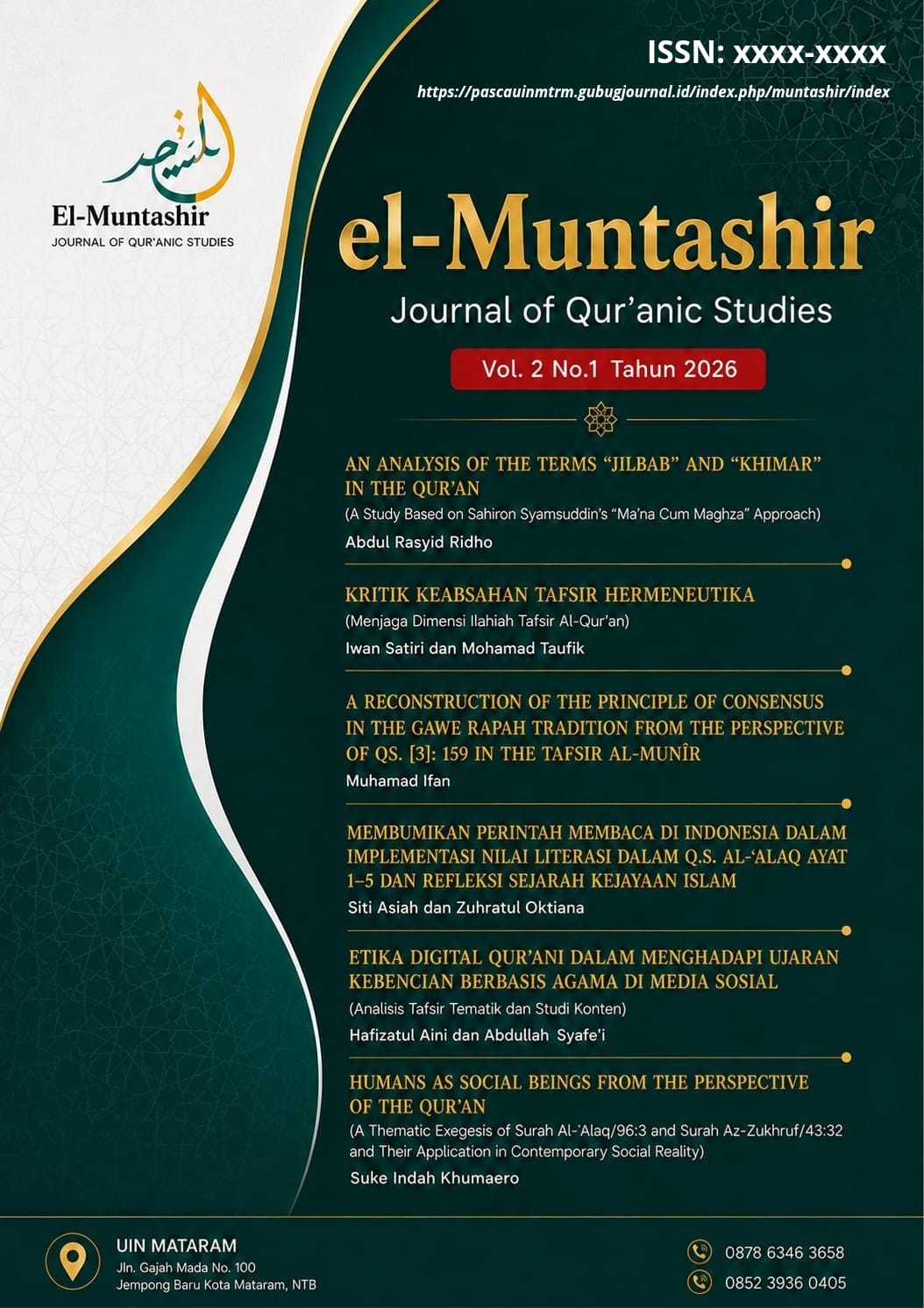
AN ANALYSIS OF THE TERMS “JILBAB” AND “KHIMAR” IN THE QUR’AN (A Study Based on Sahiron Syamsuddin’s “Ma’na Cum Maghza” Approach)
DOI:
https://doi.org/10.20414/elmuntashir.v2i1.513Keywords:
The Hajj, spiritual values, the Qur’an, Islamic moderationAbstract
The debate over the meaning of the jilbab and khimar in the Qur’an remains an evolving field of study due to differing interpretations regarding their function, form, and limits of use. These differences often give rise to claims of truth that have implications for religious practice and gender relations in society. This study aims to analyze the meaning of the jilbab in QS. Al-Aḥzāb [33]:59 and the khimar in QS. An-Nūr [24]:31 using the “Ma’na Cum Maghza” hermeneutic approach developed by Sahiron Syamsuddin, while also revealing the moral significance of these two verses in the context of Indonesian society. This study employs a qualitative approach using library research. Data were obtained from the Qur’an, exegetical texts, the works of Sahiron Syamsuddin, and various relevant scholarly sources. The analysis was conducted through stages of linguistic and historical analysis, determination of the original meaning (al-ma'nā), and contextual exploration of significance (maghza). The results of the study indicate that the terms jilbab and khimar have different meanings and functions both linguistically and historically. The main message of the two verses does not merely emphasize a specific form of clothing, but rather underscores the importance of preserving honor, dignity, safety, and morality in social life. In the Indonesian context, the significance of these verses can be understood as teachings on dress ethics, respect for the body, and moral responsibilities that apply equally to both men and women. Thus, the Ma’na Cum Maghza approach provides a more contextual and relevant understanding of the verses regarding the jilbab and khimar without neglecting the historical meanings they contain.
Downloads
Published
Issue
Section
License
Copyright (c) 2026 El Muntashir: Journal of Quranic Studies

This work is licensed under a Creative Commons Attribution-ShareAlike 4.0 International License.





 This work is licensed under a