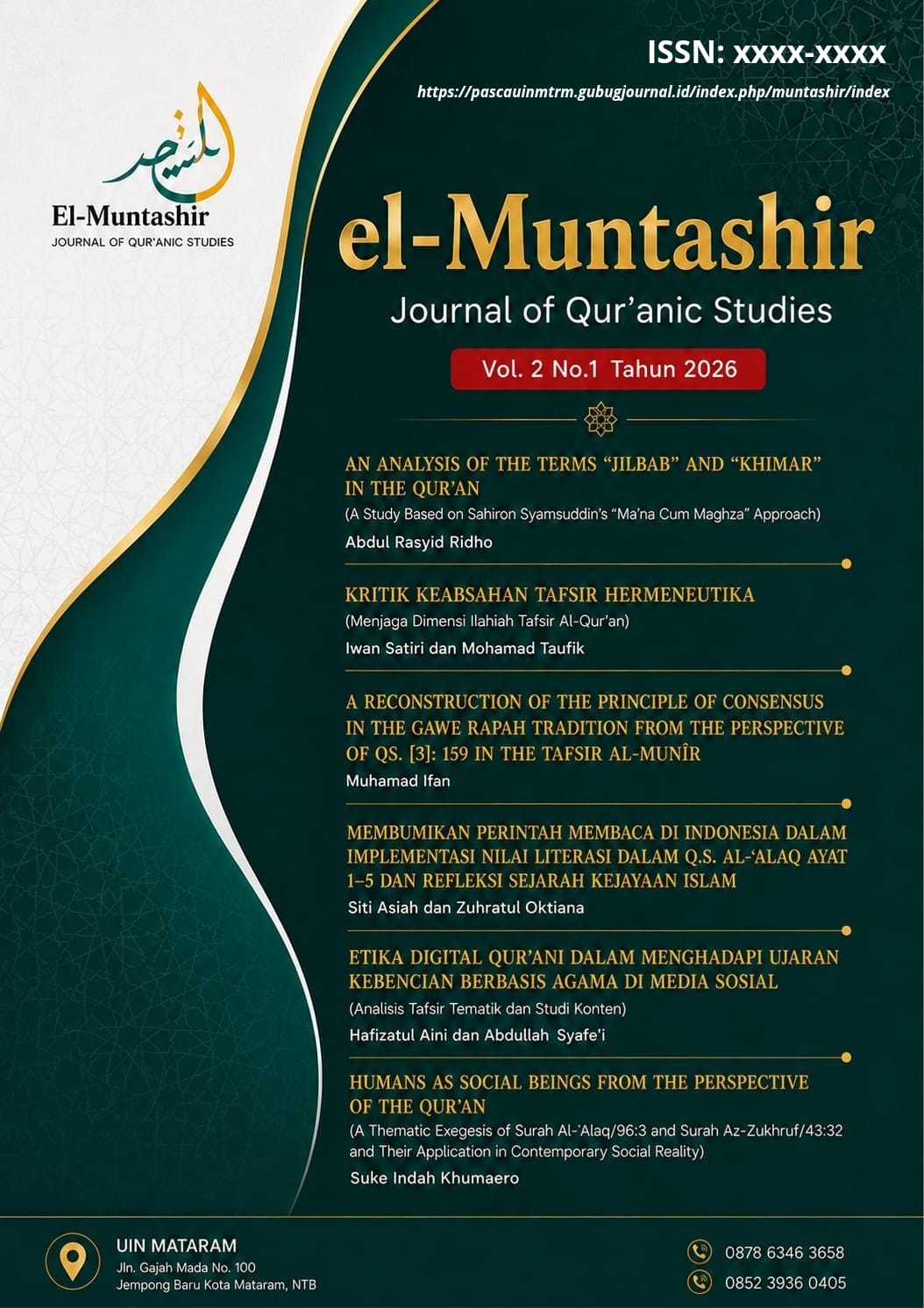
MEMBUMIKAN PERINTAH MEMBACA DI INDONESIA DALAM IMPLEMENTASI NILAI LITERASI DALAM Q.S. AL-‘ALAQ AYAT 1–5 DAN REFLEKSI SEJARAH KEJAYAAN ISLAM
DOI:
https://doi.org/10.20414/elmuntashir.v2i1.511Keywords:
Qur'anic literacy;Qur'an Surah Al-'Alaq; reading culture; Islamic civilization; Islamic education.Abstract
The low level of literacy culture in Indonesia remains a significant challenge to human resource development, despite the fact that Islam places reading as the fundamental foundation of civilization. This phenomenon reflects a gap between the normative values of the Qur'an and their implementation in everyday life. This article aims to analyze the implementation of literacy values embedded in Qur'an Surah Al-'Alaq (96):1–5 and to examine their relevance through the historical achievements of Islamic civilization as a foundation for strengthening literacy culture in Indonesia. This study employs a qualitative approach using library research. Data were collected from the Qur'an, classical and contemporary Qur'anic exegeses (tafsir), books, and relevant scholarly articles. The data were analyzed using a descriptive-analytical method within the framework of thematic (mawḍū‘ī) interpretation. The findings reveal that the command iqra' (read) extends beyond the act of reading written texts; it encompasses intellectual, spiritual, and social dimensions that encourage the pursuit of knowledge, the development of critical thinking, and the cultivation of lifelong learning. These values constituted the foundation of the flourishing intellectual tradition during the Golden Age of Islamic civilization, characterized by remarkable advances in education, the emergence of multidisciplinary scholars, the establishment of major libraries, and a strong culture of writing. In the Indonesian context, the internalization of the literacy values contained in Qur'an Surah Al-'Alaq (96):1–5 should be realized through the collaborative efforts of families, educational institutions, communities, and the government by fostering reading and writing habits, promoting critical thinking, and encouraging the responsible use of digital technology. This study concludes that contextualizing the Qur'anic message of literacy represents a strategic approach to developing a knowledgeable, ethical, and globally competitive society while reviving the scholarly spirit that once led Islamic civilization to its golden era.
Downloads
Published
Issue
Section
License
Copyright (c) 2026 El Muntashir: Journal of Quranic Studies

This work is licensed under a Creative Commons Attribution-ShareAlike 4.0 International License.





 This work is licensed under a