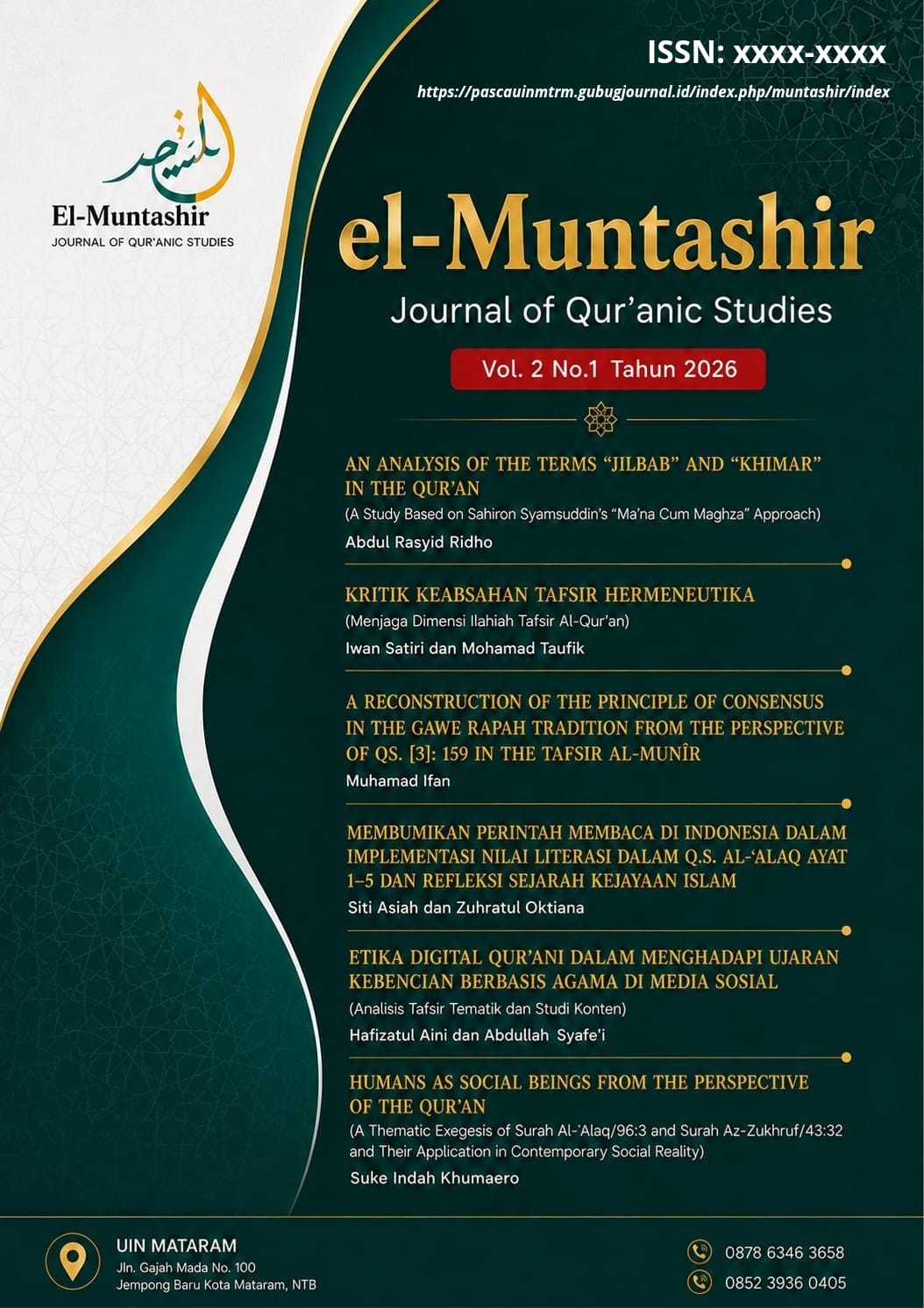
A RECONSTRUCTION OF THE PRINCIPLE OF CONSENSUS IN THE GAWE RAPAH TRADITION FROM THE PERSPECTIVE OF QS. [3]: 159 IN THE TAFSIR AL-MUNĪR
DOI:
https://doi.org/10.20414/elmuntashir.v2i1.510Keywords:
Gawe Rapah, Consultation, the Qur’an, cultural Islamization, interpretive anthropologyAbstract
One local tradition that is still practiced by the community in Mareje Village, Lembar District, Lombok Island, is the Gawe Rapah tradition. This tradition is a community deliberation forum used to resolve various social issues, while also strengthening relationships among residents. However, the development of modern society marked by globalization, technological advances, and changes in social patterns—poses challenges to the sustainability and interpretation of this local tradition. This study aims to examine the Gawe Rapah tradition by integrating the values of deliberation found in QS. [3]:159 based on the interpretation in Tafsir al-Munir, and analyzing it through the perspectives of the theory of cultural Islamization and interpretive anthropology. This study employs a qualitative approach using literature review and field research methods. Data were collected through observation, in-depth interviews with traditional leaders, religious figures, and residents of Mareje, documentation, and a review of literature related to the concept of
consultation in the Qur’an. The results indicate that the Gawe Rapah tradition plays a significant role as a mechanism for conflict resolution and
strengthening social solidarity within the community. This tradition emerged as a response to the social conflict that occurred in 2022 between the Muslim and Buddhist communities in Mareje Village. In its implementation, Gawe Rapah consists of several main ceremonies, namely the traditional deliberation, the Sopoq Tundun pledge, and the Sembeq Kending Patoh-Patoh Saling Kangen ritual, which concludes with the recitation of the cilokak. The values embodied in this tradition, such as deliberation, kindness, mutual forgiveness, and maintaining unity, align with the principles found in QS. [3]:159 as explained in Tafsir al-Munir by Wahbah al-Zuhaili. From the perspective of cultural Islamization, the Gawe Rapah tradition demonstrates a process of internalizing Islamic values into local cultural practices, particularly the values of consultation and solidarity in resolving community issues. Meanwhile, through an interpretive anthropological approach, this tradition can be understood as a symbolic system that represents the meaning of social solidarity, harmony among people of different faiths, and cultural mechanisms for maintaining social stability in the community
Downloads
Published
Issue
Section
License
Copyright (c) 2026 El Muntashir: Journal of Quranic Studies

This work is licensed under a Creative Commons Attribution-ShareAlike 4.0 International License.





 This work is licensed under a