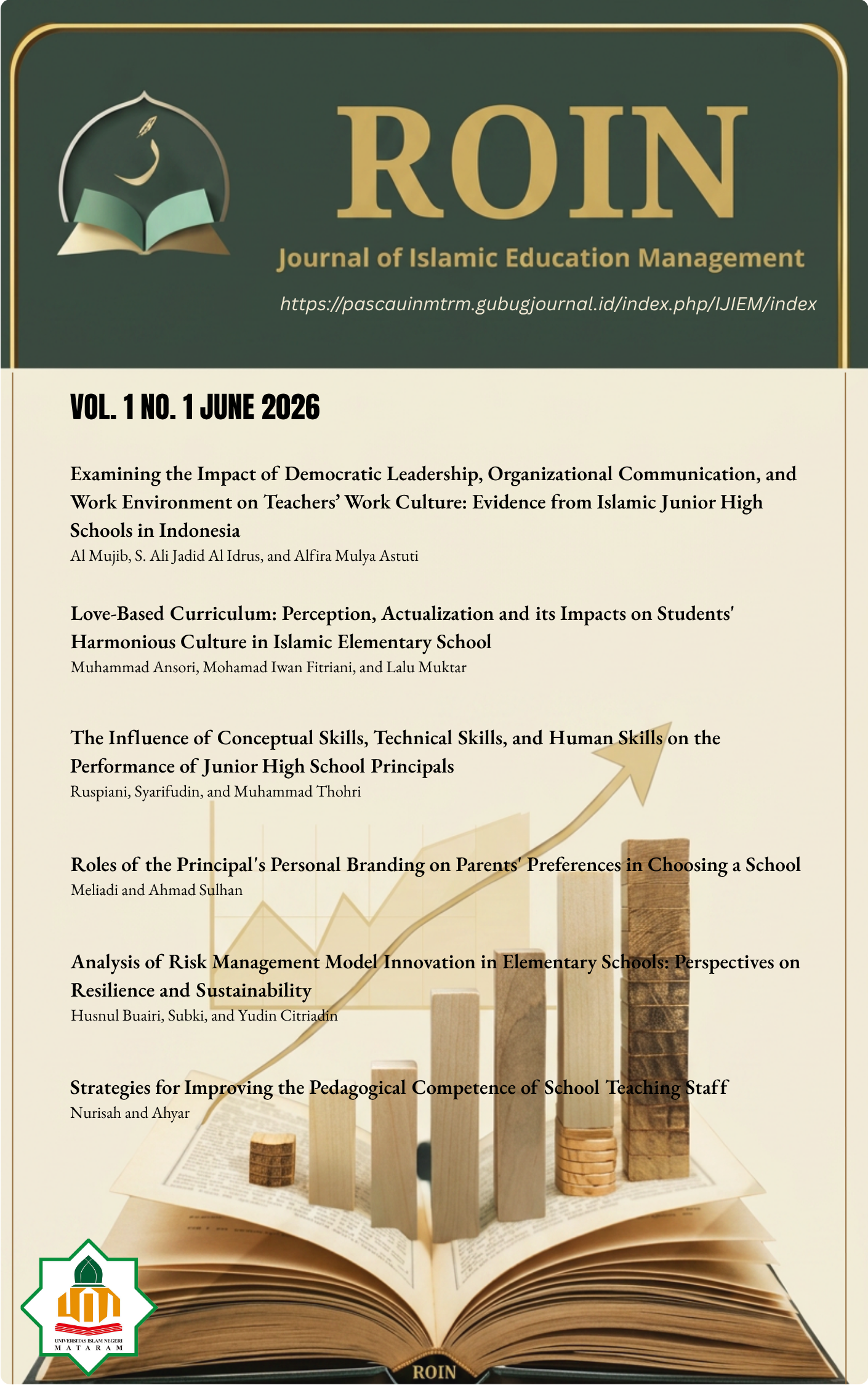
Analysis of Risk Management Model Innovation in Elementary Schools: Perspectives on Resilience and Sustainability
DOI:
https://doi.org/10.67961/rjiem.v1i1.299Keywords:
Innovation, Risk Management, Resilience, Sustainability, Elementary SchoolAbstract
[English]: This study aims to find out 1) the concept of resilience and sustainability qualitative which are applied in the risk management system, 2) innovation of risk management models in schools: perspectives of resilience and sustainability, 3) challenges in innovation of risk management models in schools: perspectives of resilience and sustainability, and 4) implications of Innovation of risk management models in schools: resilience and sustainability perspectives. The research method used is a qualitative approach with a multi-case study design. Data was collected through in-depth interviews with principals, teachers, and education staff, as well as through documentation and field observations. Data analysis is carried out with the stages of data collection, simplification, presentation, and conclusion verification to ensure the accuracy and validity of the findings. The results of the study show that the innovation of the risk management model in both schools can strengthen the resilience and sustainability of the school through adaptive planning, strengthening SOPs, efficient resource management, and the involvement of all school residents. MIS Liqa'ul Amal develops a risk management model based on community participation and internalization of religious values as a reinforcement of school resilience in the face of limited resources. Meanwhile, SDN 4 Senyiur implements a more formal and systematic risk management model through regulations and government policy support. Despite challenges such as limited facilities, policy changes, and human resource readiness, risk management innovations in both schools have positive implications for improving preparedness, operational stability, and sustainability of education quality.
[Indonesian]: Penelitian ini bertujuan untuk mengetahui 1) konsep kualisasi resilience dan sustainability yang diterapkan dalam sistem manajemen resiko, 2) inovasi model manajemen resiko dalam sekolah: perspektif resilience dan sustainability, 3) tantangan dalam inovasi model manajemen resiko dalam sekolah: perspektif resilience dan sustainability, serta 4) implikasi dari inovasi model manajemen resiko dalam sekolah: perspektif resilience dan sustainability. Metode penelitian yang digunakan adalah pendekatan kualitatif dengan desain studi multi kasus. Data dikumpulkan melalui wawancara mendalam dengan kepala sekolah, guru, dan tenaga kependidikan, serta melalui dokumentasi dan observasi lapangan. Analisis data dilakukan dengan tahapan pengumpulan data, penyederhanaan, penyajian, dan verifikasi kesimpulan untuk memastikan keakuratan dan validitas temuan. Hasil penelitian menunjukkan bahwa inovasi model manajemen resiko di kedua sekolah mampu memperkuat resilience dan sustainability sekolah melalui perencanaan yang adaptif, penguatan SOP, pengelolaan sumber daya secara efisien, serta keterlibatan seluruh warga sekolah. MIS Liqa’ul Amal mengembangkan model manajemen resiko berbasis partisipasi komunitas dan internalisasi nilai religius sebagai penguat ketahanan sekolah dalam menghadapi keterbatasan sumber daya. Sementara itu, SDN 4 Senyiur menerapkan model manajemen resiko yang lebih formal dan sistematis melalui regulasi dan dukungan kebijakan pemerintah. Meskipun menghadapi tantangan seperti keterbatasan fasilitas, perubahan kebijakan, dan kesiapan sumber daya manusia, inovasi manajemen resiko di kedua sekolah berimplikasi positif terhadap peningkatan kesiapsiagaan, stabilitas operasional, serta keberlanjutan mutu pendidikan.
Downloads
Published
How to Cite
Issue
Section
License
Copyright (c) 2026 Husnul Buairi, Subki, Yudin Citriadin

This work is licensed under a Creative Commons Attribution-ShareAlike 4.0 International License.